Point a subdomain of your own at allGood, with an SSL certificate allGood issues and renews for you.
Everything in this section needs an address. Before a domain is connected, the tracking tag has nowhere to load from, forms have no endpoint, and landing pages have nowhere to be served.
A subdomain of a domain you already own — mk.brand.com is the convention — pointed at allGood. Once it’s live, it serves:
your hosted landing pages, at https://mk.brand.com/{slug}
form capture, at https://mk.brand.com/_ag/f/{formId}
event capture, at https://mk.brand.com/_ag/e
the tracking script, at https://mk.brand.com/_ag/v1.js
click redirects for tracked links in your email
The /_ag/ path is reserved by allGood. Everything else at the root is yours.
Use a subdomain you aren’t already serving something from. Pointing a hostname at allGood takes it over completely — it will serve allGood pages, not your site.
Access to your DNS provider, or someone who has it.
The Admin role in allGood.
A subdomain decided. mk. is conventional, but anything you aren’t using works.
1
Register the hostname
Go to Settings → Web Edge. In Add a subdomain, type the full hostname — mk.brand.com, not mk and not brand.com — and click Register.
The Add a subdomain card, where you register the hostname.
2
Open the DNS instructions
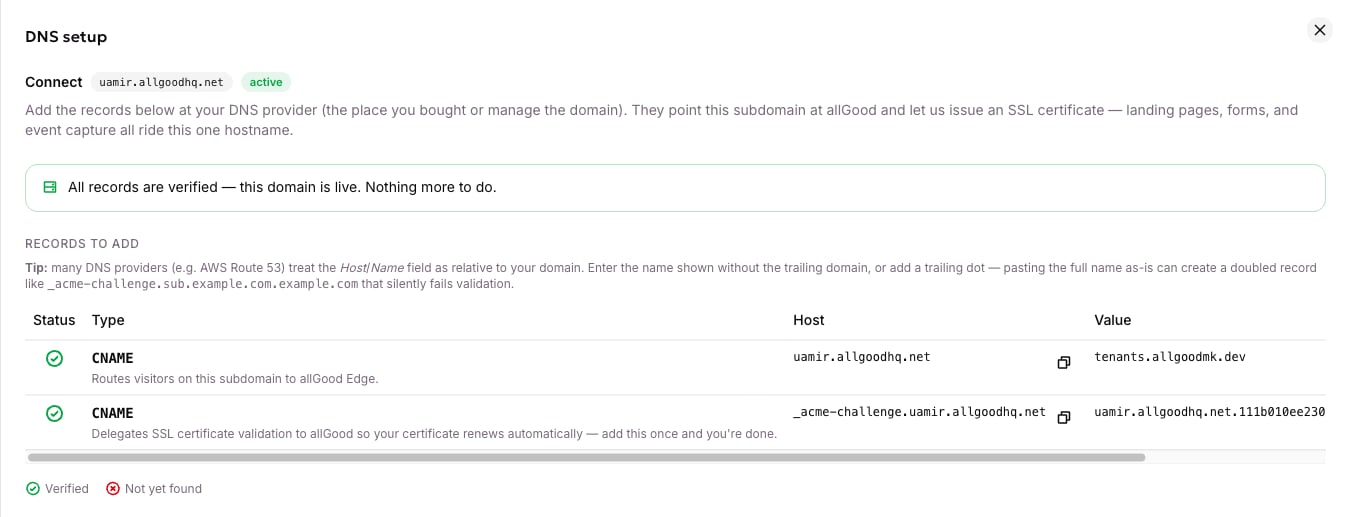
On the new row, open the ⋮ menu and choose DNS setup instructions. A drawer lists every record you need, each with a copy button and a live tick showing whether it has resolved yet.
3
Add the routing record
There is always a CNAME that sends visitors on your subdomain to allGood.
Field
Value
Type
CNAME
Host
mk.brand.com
Value
The CNAME target shown on the row
4
Add the certificate record
The second record proves you own the domain, so allGood can issue an SSL certificate for it. The drawer shows one of two shapes.A delegation CNAME — one record, added once, and renewal is automatic from then on:
Field
Value
Type
CNAME
Host
_acme-challenge.mk.brand.com
Value
The value shown in the drawer
Or TXT records, at _acme-challenge.mk.brand.com. There may be more than one — add every record shown. Missing one means a backup certificate authority can silently fail to renew later.
5
Watch for the trailing-dot trap
Most DNS providers treat the Host or Name field as relative to your zone. Pasting the full name as shown produces a doubled record that fails silently:
_acme-challenge.mk.brand.com.brand.com ← wrong
Enter the name without your domain suffix — _acme-challenge.mk — or add a trailing dot if your provider supports absolute names. This is the single most common setup failure.
6
Wait, then press Sync
DNS takes anywhere from a few minutes to about an hour. Press Sync on the Web Edge screen to re-check; the list refreshes about 30 seconds later.
The domain table, showing the four-step progress rail and the default domain badge.
Each row shows four steps:
Step
Means
Hostname created
allGood has registered the hostname
DNS propagated
Your routing record is visible
SSL active
The certificate is issued and deployed
Bot protection ready
The bot-check widget covers this hostname
The fourth finishes after the others — a widget can only cover a hostname once its certificate is live. If a domain shows SSL active but not Bot protection ready, press Sync again.
7
Confirm every record is verified
Reopen the DNS drawer. When both records resolve you get green ticks and a confirmation that the domain is live.
The DNS drawer once every record has resolved and the domain is live.
A domain shows propagating while it waits on DNS and the certificate, then active once it’s serving. Only active counts as connected.
If a domain has sat in propagating for more than an hour or two, treat it as broken rather than slow. Re-check every record against the DNS drawer, watching for the doubled-name problem above.
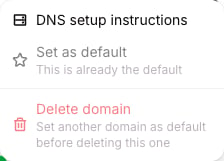
You can connect more than one domain. One of them is the default: the one allGood fills into every snippet it generates — the tracking tag, the GTM template, form endpoint URLs, published page URLs.Set it from the row’s ⋮ menu. Only an active domain can be the default, and there’s only ever one.
The row actions menu, with DNS setup instructions, Set as default and Delete domain.
⋮ → Delete domain, then type the hostname to confirm. Landing pages, form capture and event capture on that domain stop working immediately. You can’t delete the default — make another domain the default first.
Before a domain is connected, and afterwards for testing, allGood also serves a platform preview host of the shape {yourTenantId}.preview.allgoodmk.app. Signed page previews and the hosted test page live there. It isn’t a substitute for a connected domain — it isn’t branded, and it isn’t where real traffic goes.