

Classify → Fetch → Extract → Enrich → ActionsOnce the contact is enriched, those values become variables you can reference in that category’s actions — for example, setting a Marketo
Title field from the enriched job title, or creating a brand-new lead for a replacement contact with their company already filled in.
Enrichment is optional and configured per category. A reply that lands in Left Company might enrich a newly-extracted contact; one that lands in Unsubscribe needs no enrichment at all.
This page covers wiring enrichment into a Reply Management category. For help building or tuning the enrichment profile itself — picking Basic vs. Advanced mode, choosing data providers, and deciding which fields to look for — start with the Enrichment Setup Guide, or read Lead Enrichment for how enrichment works across allGood.
Adding enrichment to a category
Navigate to Reply Management → Categories & Actions, then click Enrich on the category row to open the enrichment panel. The panel has two parts: who to enrich (the enrichment input) and which profile to enrich them with.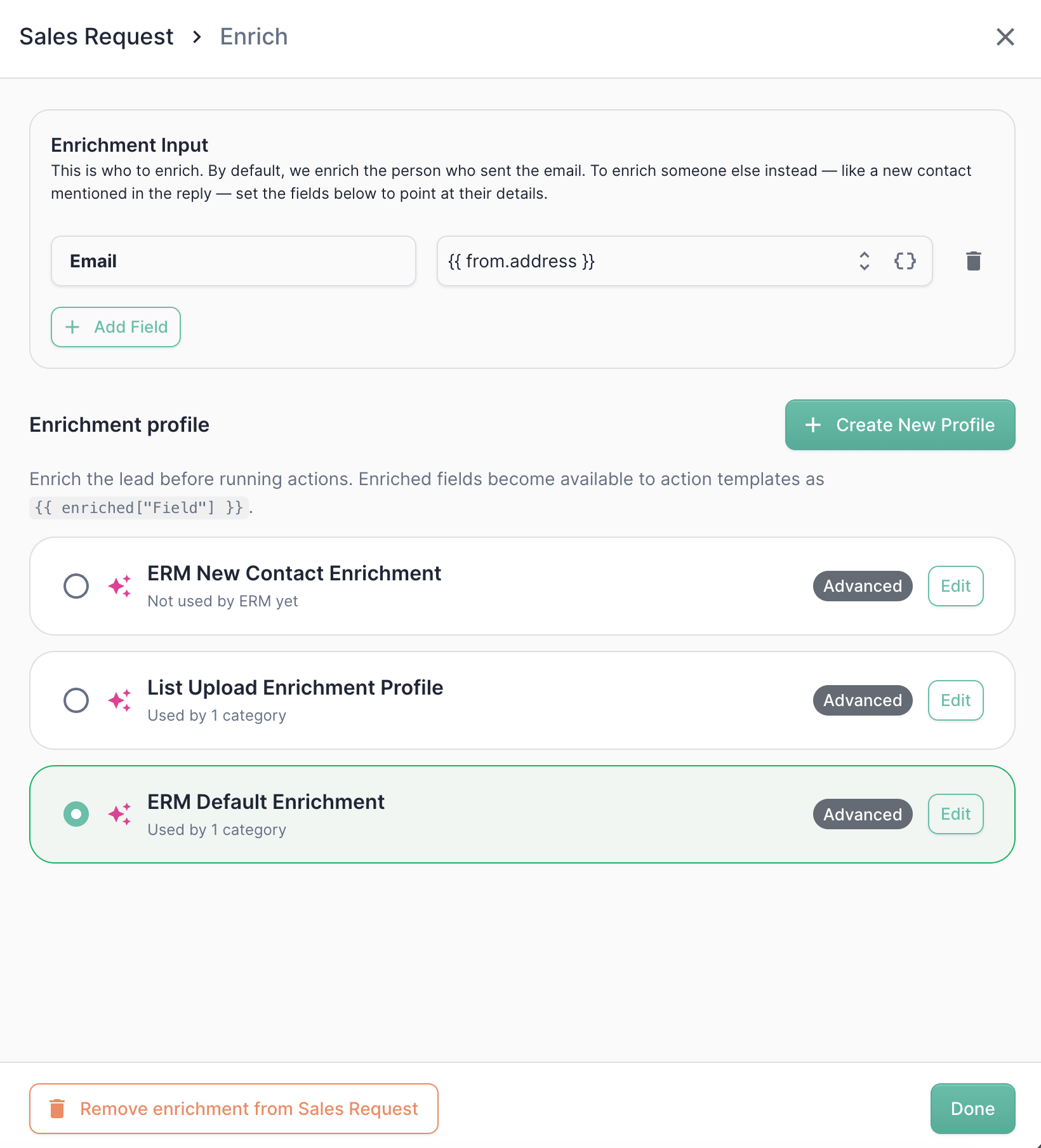
The enrichment panel, set to enrich the person who sent the reply
1
Choose who to enrich
By default, Mary enriches the person who sent the reply. Point the input somewhere else to enrich a different contact — see Enrichment input below.
2
Select an enrichment profile
Pick a profile from the list, or click Create New Profile. The profile decides how enrichment runs — which data providers to use and which fields to look for.
3
Click Done
Your enrichment configuration is saved with the rest of the category. Click Save & Publish on the Categories & Actions page when you’re ready to push it live.
4
Use the enriched fields in your actions
Reference the results in that category’s Actions with
{{ enriched["Field"] }}.Enrichment input (who to enrich)
The Enrichment Input section controls whose details Mary looks up. By default she enriches the person who sent the email — the input ships pre-set to the sender’s address. To enrich someone other than the sender — most commonly a new contact mentioned in the reply — click + Add Field and map one or more fields to a value from the email. Each row is a pair:- Field — what the value is, in enrichment’s vocabulary (
Email,First Name,Last Name,LinkedIn URL,Company) - Value — where to find it, as a token. This can reference the sender (
{{ from.address }}), an extracted field ({{ extractedFields["newContactEmail"] }}), or fetched CRM data
Email row is a perfectly valid input, and often it’s all a reply gives you. Add more rows only when the reply reliably contains more; each extra field gives enrichment another signal to match on, but a blank one costs you nothing.
The Field name matters — it tells Mary what each value represents so she can run the right lookups (an
Email drives email-based lookups, a LinkedIn URL drives LinkedIn lookups, and so on). Stick to the suggested names so the value is actually used.Enrich the sender (default)
Enrich the sender (default)
Leave the input untouched. Mary enriches whoever sent the reply.
Enrich a new contact extracted from the reply
Enrich a new contact extracted from the reply
In a
Left Company category, you might extract a replacement contact’s details, then enrich them instead of the sender.Enrich a new contact when all you have is their email
Enrich a new contact when all you have is their email
Plenty of replies name a replacement contact by email address and nothing else. That’s enough — map the email on its own and let enrichment fill in the name, title, and company.
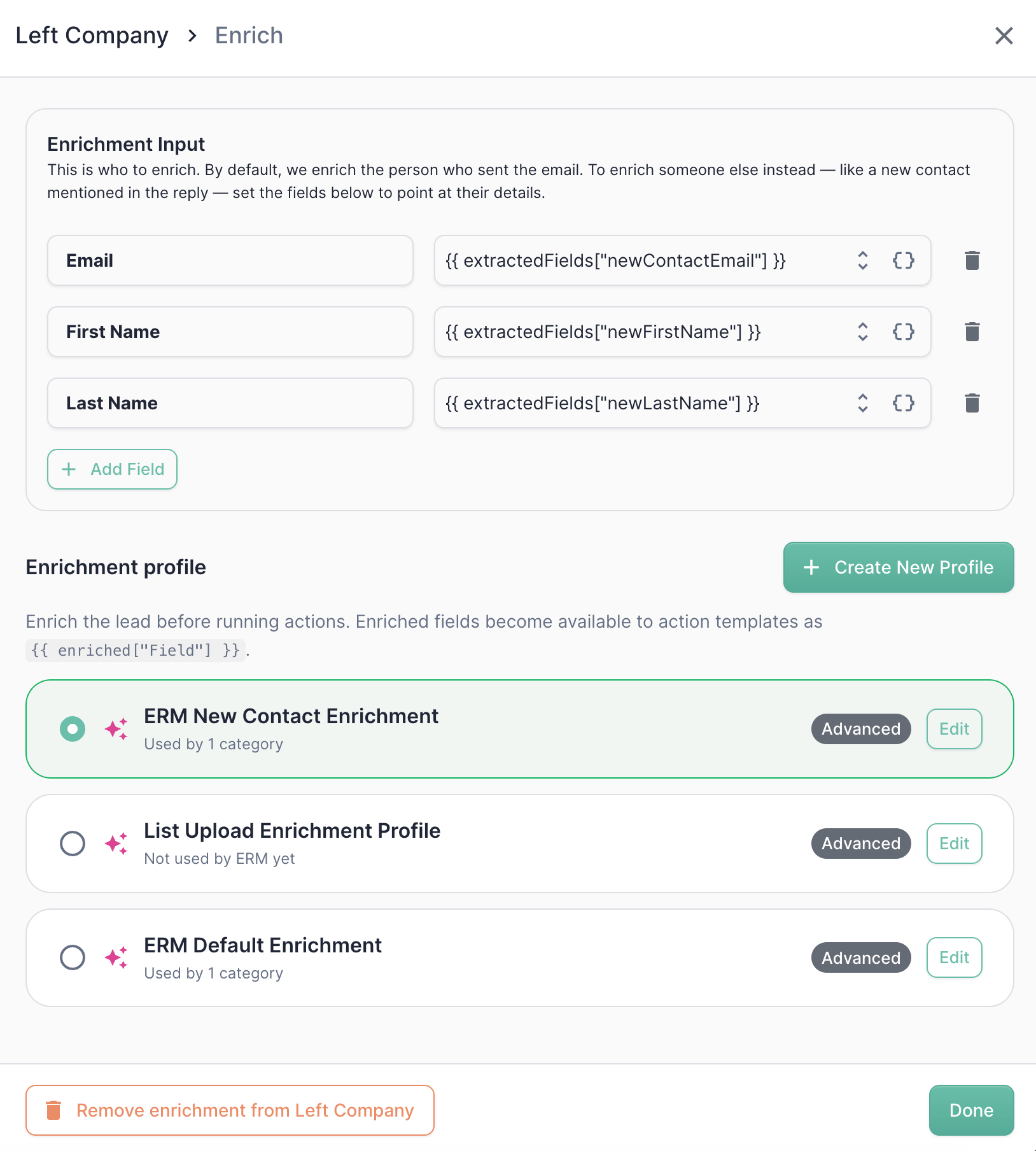
Enrichment input pointed at a replacement contact extracted from the reply
Choosing an enrichment profile
An enrichment profile is a reusable recipe for how to enrich a contact — which data providers to use, which fields to look for, and when to skip. The same profile can be shared across many categories, and across other parts of allGood such as List Upload. From the enrichment panel you can:- Select a profile — click any profile in the list to use it for this category. The selected profile is highlighted, and each row shows whether it’s an Advanced or Basic profile plus how many categories already use it.
- Create a new profile — click Create New Profile to spin one up and open it for editing.
- Edit a profile — click Edit on any profile to change its fields, providers, and run conditions.
Configuring a profile’s internals — enrichment mode, the fields to find, provider lookups, and when-to-run rules — is covered in the Enrichment Setup Guide. See Lead Enrichment for how enrichment works more broadly.
Using enriched values in actions
Once a contact is enriched, each field the profile produced is available as a variable in that category’s Actions. Reference it with theenriched token:
{} token picker on any action field and choose Enriched Fields to see everything the enrichment step produces.
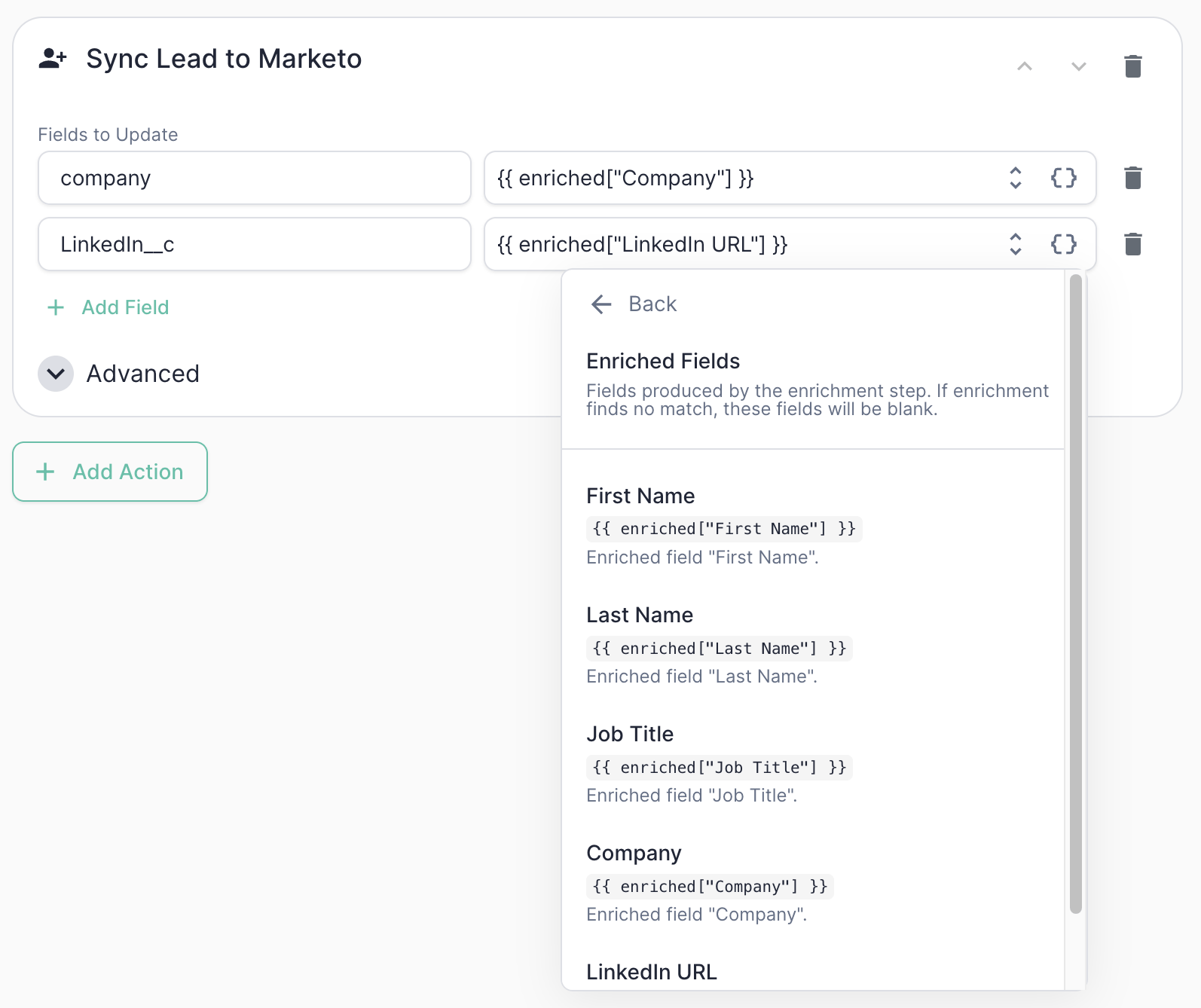
Picking enriched fields from the token picker in a Sync Lead to Marketo action
Example: enrich a replacement contact from a “Left Company” reply
A common pattern: someone has left, the reply names their replacement, and you want to create that replacement as a fully-enriched lead in Marketo.1
Extract the new contact
In the
Left Company category’s Data Extraction, capture the replacement’s details.2
Enrich that contact
In the enrichment panel, point the input at the extracted contact and pick a profile — here, one built for new contacts rather than the workspace default.
Only
Email is needed here — drop the name rows if your replies don’t reliably include them, and enrichment will resolve the name itself.3
Create the enriched lead in Marketo
Add a Sync Lead to Marketo action (
Create or Update) that identifies the lead by the extracted email and fills the rest from the enriched values.How enrichment behaves
- Skipped when not configured. Categories without an enrichment profile skip the step entirely — no credits consumed.
- Skipped when there’s nothing to enrich. If the input resolves to no contact — for example, no replacement email was extracted — enrichment is skipped for that reply.
- Blank fields, not errors. If enrichment runs but finds no match, the
enrichedfields come through empty rather than failing the reply. Downstream actions still run, so guard anything load-bearing with an only runs if condition. - The profile decides when to run. A profile can be set to only enrich when data is missing, so Mary won’t burn credits re-fetching fields you already have. See the Enrichment Setup Guide.
- Every run is traceable. Open a reply in Messages to see the enrichment result — which providers were tried, what was found, and the full agent run.